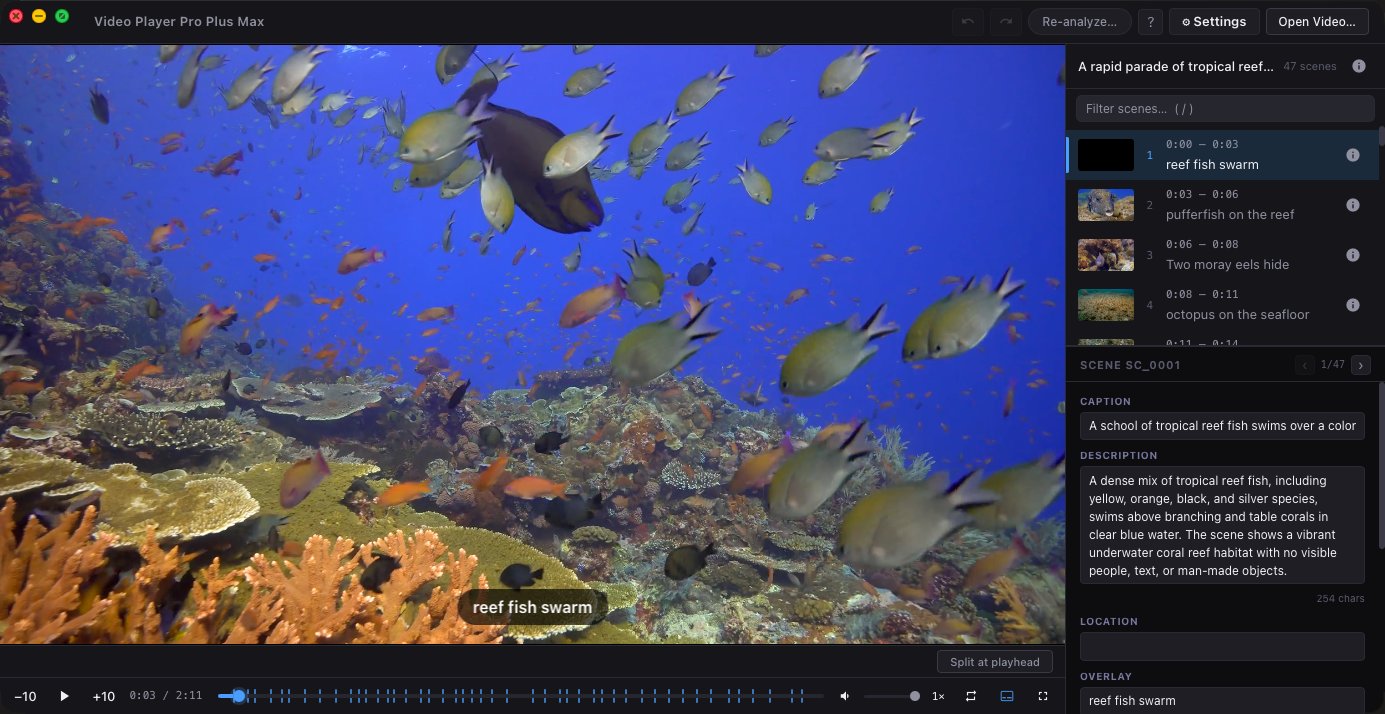
A video is challenging to review if you're looking for a specific scene. Automatically describe a video's scenes and make it easy to navigate through them during playback.
Video Player Pro Max describes what happens inside a video so you can understand and quickly access scenes in a video player. It writes a plain-language description, keywords, and a short on-screen caption for each scene, plus a summary of the whole video. Everything is saved in a small sidecar file next to the video, so the results travel with the footage and can be read by other programs later. Multi-lingual support is included.
A desktop app plays the video beside an editable scene list: click a scene to jump to it. Scrub the video and the list follows along. Split, delete, and reorder scenes, fix any field, and re-run analysis on just the parts you changed. A companion Android app brings the same scene-aware playback to a phone or tablet, read-only. A search field filters the scene list.
Analysis runs on your own computers with local models or through cloud AI providers. Nothing has to run in the cloud, and it installs as a normal app on macOS and Windows with nothing else to set up. (The one exception: local scene analysis requires installing Ollama. Cloud analysis needs nothing extra.)
Features
- Finds the scenes in a video automatically, including soft transitions like cross-dissolves that most detectors miss
- Writes a description, keywords, a location, and a short on-screen caption for every scene
- Writes a summary of the whole video, built from what it saw in each scene
- Saves everything in a small companion file next to the video, so results travel with the footage and other programs can read them later
- Click a scene to jump to it; scrub the video and the scene list follows along, with tick marks on the scrubber showing where scenes begin
- Split, delete, and reorder scenes, and edit any detail; changes save safely back to the companion file
- Watch analysis happen live, scene by scene, cancel at any time, and re-run just the parts you changed
- Android companion app brings the same scene-aware playback to a phone or tablet, with captions, a searchable scene list, and gesture controls: swipe between scenes, drag to scrub with speed-sensitive seeking, drag for brightness and volume
- Frame-accurate timecode on desktop and Android, the kind professional editors expect
- Analysis runs on your own computers, through cloud AI services (OpenAI, Gemini, Grok, Anthropic), or a mix of both
- Settings screen verifies API keys and checks your setup for problems
- Choose the language the descriptions are written in
- Installs like a normal app on Mac and Windows, with everything needed built in
Under the hood
- —Hybrid scene detection: PySceneDetect AdaptiveDetector catches hard cuts, two ffmpeg scene-filter passes (a decimated dissolve-tuned pass and a full-rate residual pass) catch soft transitions, and boundary clusters collapse to their mean so a cross-dissolve registers as one boundary at its center
- —Scene assembly is gapless and uncapped: sub-threshold spans merge into the following scene, one keyframe per scene at the midpoint, detection parameters recorded in the sidecar for reproducibility
- —Engine subprocess emits 8 NDJSON event types on stdout (video_start, scenes_detected, scene_result, synthesis_start, progress, video_skipped, video_done, error); Tauri frontend consumes the stream verbatim: no localhost server, cancel = kill process, partial sidecars are safe by construction
- —JSON sidecar per video with versioned schema, unknown-field preservation, and scene-level idempotency, so re-runs only touch what changed
- —One pool interface spans local Ollama workers and cloud providers (two request shapes, OpenAI-compatible and Anthropic messages), with per-worker AIMD concurrency: ramps up on clean runs, halves on rate limits, and resubmits throttled requests instead of marking workers down
- —Location extraction is split by evidence type: the per-scene vision model reports only what is visible (signs, landmarks), while whole-video synthesis owns inference from file paths and GPS, with the prompt marking the file path as trusted context so cloud models will use it
- —Android seek gesture is velocity-based: slow drags scrub about 1.5 s/cm, faster drags accelerate superlinearly to a duration-aware cap, and dragging back toward the origin unwinds to exactly zero; on-screen display shows frame delta and SMPTE drop-frame timecode during the gesture
The original prompt
This whole project started from a single prompt to Claude Code. Reproduced verbatim below, it is the seed everything above grew from.
I have a video analysis engine set up that does scene detection, analyzes the middle frame of every scene, and synthesizes the batch of keyframe metadata into a summary. I want to copy that work and modify it into a dedicated video metadata analysis and metadata storage system.
High level goal: analyze a video in the same way--scene detection, per-scene image analysis, whole-video metadata synthesis. write metadata sidecar file that contains scene markers, scene descriptions including keywords and other metadata, whole-video summary, and abbreviated scene summaries suitable for on-screen overlay (extremely concise).
Blazingly fast, gorgeous, performant UI using best practices from the best consumer video apps and how apps SHOULD behave (vs functional apps with crappy UIs), efficient, thoroughly tested before asking the founder for input.
Metadata generation should include not only the information from the video itself including all available metadata, but also, full path and file names, which may aid analysis (e.g., locations, dated, subjects that may be named in the path).
There should be an accompanying desktop-accessible editor with a video player, scene list with full metadata read out for each selected scene, interaction between the scene list and video player (e.g., clicking on the scene jumps to the scene, playing and scrubbing the video updates the associated scene selection). The editor should allow for scene edits (scene deletion, new scene creation by something like splitting at current playhead--new scene should be able to manually be analyzed by clicking on an analyze button that queues the scene to the ollama analysis engine, scene start/end point edits, metadata editing of all fields). The edits should be saveable into the same sidecar file. The sidecar file should be as standard as possible leverating either Lightroom-style sidecar files, and/or a well-described json that could be read easily by future programs via inspection.
The desktop-accessible editor needs to run in both OSX and Windows. It should be standalone and allow CLI-based analysis of one or more video files as arguments, supporting whole-folder ingest. It should be idempotent; if a video has already been processed, do not reprocess it. If possible, do this at the scene level, but if this proves to be too challenging, per-video analysis detection is fine. it should use the multi-machine / farm ollama based image analysis platform in the other project (specified below).
If a video is opened in the editor / GUI, it should support "Analyze video", which will queue up analysis of the single video, be multithreaded so the UI never slows down, and show realtime progress of the analysis, showing number of scenes detected with info about each scene, and viewing of all metadata as it comes in from the analysis engine. It should also have a "Cancel analysis", which kills current analysis (or removes from the queue of other videos are also processing at the same time in the queue).
Existing project to scan for video metadata analysis: /original/project/folder/name [redacted]. Do not modify the other project. read only.
Plan this project carefully using subagents as needed. The plan should be comprehensive, and you should document it in a way that can be continued by a new instance of Claude with context cleared. Use git for progress snapshots. Ask any questions you need to do this properly.